Press kit
Share with press or investors
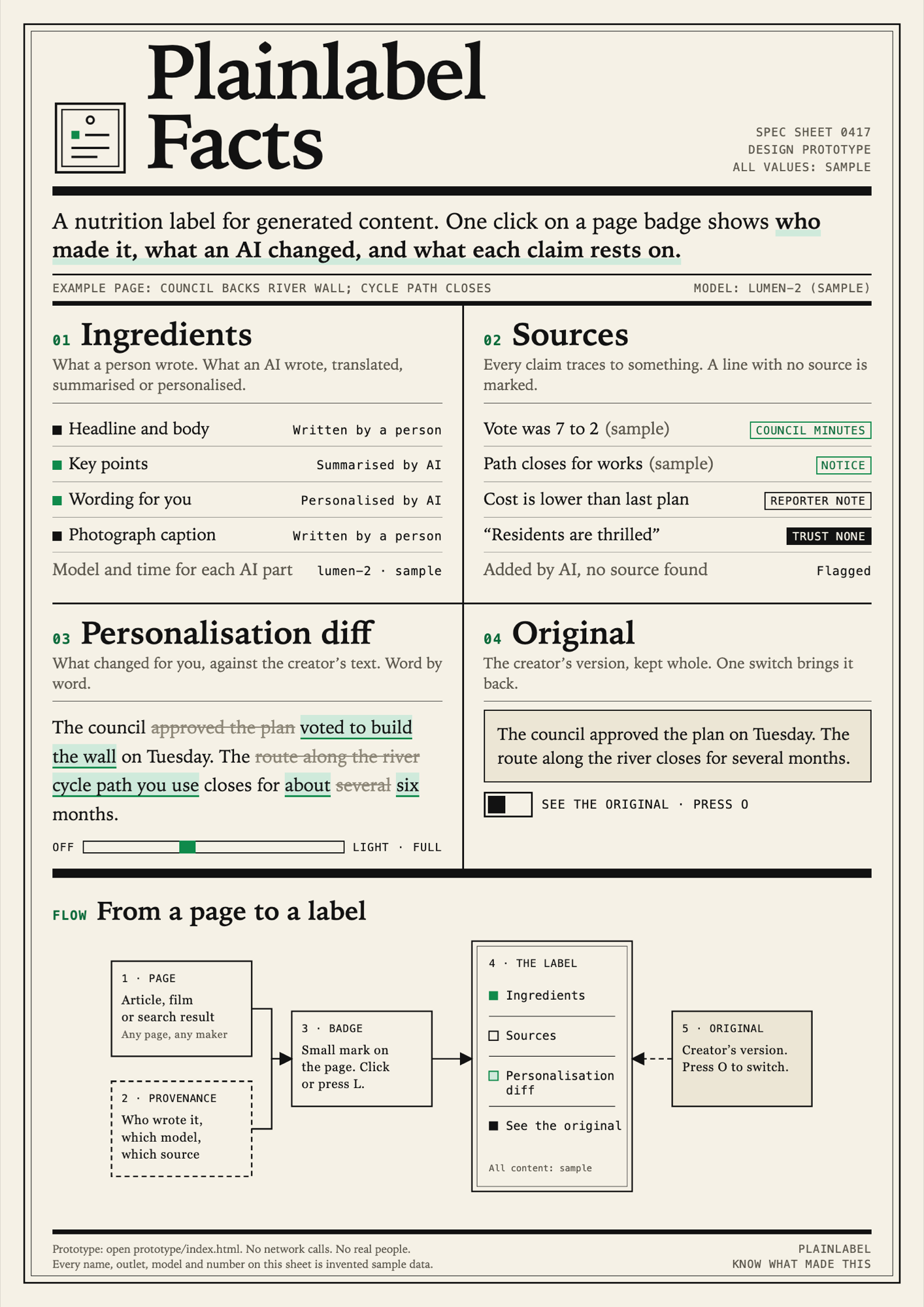
A nutrition label for generated content.
Style: Museum archive labels. Built in HyperFrames from animated SVG, with an instrumental bed and synthesised sound effects. Download the mp4.
You cannot tell how a generated page was made, or who changed it for you.
More of the web is generated as you read it. A page can be personalised, and the creator's point can drift or vanish. Readers have no common label that shows the source, the changes and the original.
A label, like a nutrition label, opens from a button on the page. It shows how the page was made and a diff against the original. A slider personalises the text, and a drift check warns when the meaning changes. One click restores the creator's version.
We believe readers accept personalised content when they can see and undo every change in one click. If it holds, a label does not need to interrupt browsing. To confirm: pages and labels are simulated and the drift check is scripted.
The prompts that made this prototype, in order. Lightly trimmed.
Using the futureoftheweb.org API key and the video and prototype workflow from earlier prototypes, create 3 to 4 prototypes and launch videos for these themes: Know (Search Beyond the Web), Learning and Attention, Navigating Generated Content, Human-Agent Workflows. Explore an OpenRouter or Runlayer-style product for consumers and enterprise, and lead generation for local service businesses. Each one needs a launch video, an interactive prototype, distinct branding, and a cost report for orchestration, video and prototype. Ask no questions.
Orchestrator brief to each builder: ship one interactive single-file prototype, one 20 to 26 second launch video built in HyperFrames in an assigned style, and a cost report. Hard spend cap of $0.60 per video. No invented statistics. No generated people. Plain words. Look at 12 frames before you report.
Also use Gemini video models on the work Google account for video, and give me 3 to 5 other ways to show each prototype besides a URL and a video.
Wicket looks like separate components, not one unified app with proper UI and UX. I want all of them like that. Rebuilt each prototype as one app: one shell, hash routes, one shared state store, one design system, onboarding, a command palette, and an end-to-end test.
Publish each prototype at futureoftheweb.org/p/ and put the video, the prompts and the tokens on each prototype page as tabs, like the earlier prototypes. Add the other formats too: press kit, spec poster, comic, deck.
The prototypes look squished and not full page. Fix the embed so each one fills the page.
Builder brief for Plainlabel: A nutrition label for generated content. Problem: More of the web is generated as you read it. You cannot tell how a page was made, who changed it for you, or whether it kept the creator's point. Questions to answer: How might we trace and verify generated content without interrupting browsing? How might we keep different views when content is personalised? How might we keep the point the creator meant?
| Step | Total tokens | Real spend (USD) | Note |
|---|---|---|---|
| Video and prototype build (sub-agent) | 201,542 | $0.15 | WaveSpeed music $0.15 measured |
| Extras: press, poster, comic, deck (sub-agent) | 114,153 | $0.00 | |
| Unified-app rebuild and e2e (sub-agent) | 231,564 | $0.00 | |
| Total | 547,259 | $0.15 |
Tokens are the sub-agent totals that Claude Code reported. Input and output are not split. The orchestrating session's own tokens were not metered. Token cost is not converted to dollars because the work ran on a subscription.
Real spend is the WaveSpeed music charge. Sound effects, rendering and the prototype itself cost nothing outside the subscription. No Veo or Gemini video call ran.
Share with press or investors
Print it or pin it on a wall
Explain the story in a minute
Present it in a meeting